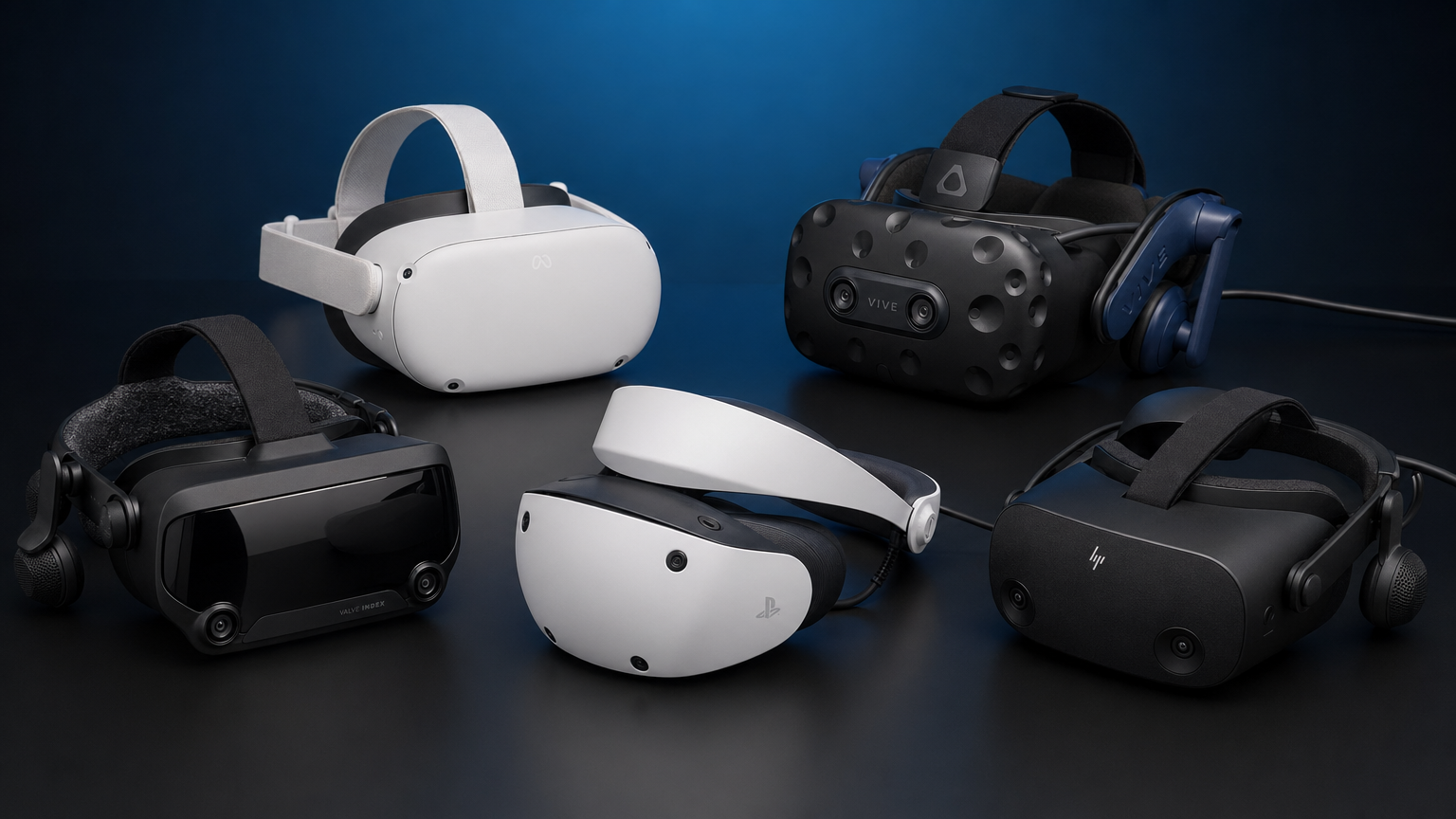
Two of the most compelling VR headsets of 2025 go head to head. The Meta Quest 3 and PlayStation VR2 represent very different philosophies in virtual reality design — and for Australian buyers, the right choice depends heavily on your existing setup, gaming habits and budget.
Overview: Two Very Different Approaches
The Meta Quest 3 is a standalone headset that requires no external hardware. It runs on Qualcomm's Snapdragon XR2 Gen 2 processor, offers full-colour mixed reality passthrough, and connects wirelessly to a massive library of VR titles via the Meta Quest Store and PC Link.
The PlayStation VR2, by contrast, requires a PlayStation 5 console and connects via a single USB-C cable. It delivers a premium OLED display with eye-tracking, adaptive trigger support through the Sense controllers, and access to Sony's growing library of exclusive VR titles.
Display Quality
Both headsets offer impressive displays, but with notable differences. The PSVR2's OLED panels deliver deeper blacks and more vivid colours than the Quest 3's LCD displays. However, the Quest 3 offers a higher resolution per eye (2064 × 2208 versus 2000 × 2040) and a wider field of view.
In practical terms, the PSVR2 feels more cinematic for narrative experiences, while the Quest 3 provides slightly sharper text and detail in productivity and mixed reality applications. For gaming, both are excellent — the difference is subtle enough that most users won't notice it in the heat of play.
Game Libraries
This is where the two headsets diverge most significantly. The Meta Quest Store boasts hundreds of titles, with new releases arriving weekly. The platform supports both standalone play and PC VR via Air Link or a USB-C cable, giving Quest 3 owners access to the entire SteamVR library as well.
The PSVR2 library is smaller but growing, with Sony investing heavily in exclusive titles. Games like Horizon Call of the Mountain, Gran Turismo 7 VR and Resident Evil Village VR Mode demonstrate the platform's potential. If you already own a PS5 and enjoy Sony's first-party franchises, the PSVR2 library is genuinely compelling.
Comfort and Fit
The Quest 3 is lighter and more compact than its predecessor, though the front-heavy design can cause fatigue during extended sessions. A third-party head strap (such as the Elite Strap) significantly improves comfort and is recommended for sessions longer than an hour.
The PSVR2 uses a halo-style headband that distributes weight more evenly across the head, making it more comfortable out of the box for most users. The Sense controllers are ergonomically excellent, with the adaptive triggers and haptic feedback adding genuine immersion to supported titles.
Our Verdict for Australian Buyers
For most Australians, the Meta Quest 3 is the better choice. Its standalone functionality, massive game library, mixed reality capabilities and PC VR compatibility make it the most versatile VR headset available. It's the ideal choice for families, newcomers and enthusiasts who want one device that does everything.
The PlayStation VR2 is the right choice if you already own a PS5 and are deeply invested in Sony's gaming ecosystem. The OLED display, eye-tracking and haptic feedback deliver a premium experience for supported titles — but the requirement for a PS5 and the smaller library make it a more niche proposition.
Both headsets are available from major Australian retailers including JB Hi-Fi, Harvey Norman and EB Games, with manufacturer warranty support available locally.